Before You Treat the Wound,
Ask What Is Driving It.
Every wound has a context.
Understanding the cause, patient factors and wound characteristics helps create a more structured approach to wound assessment and management.
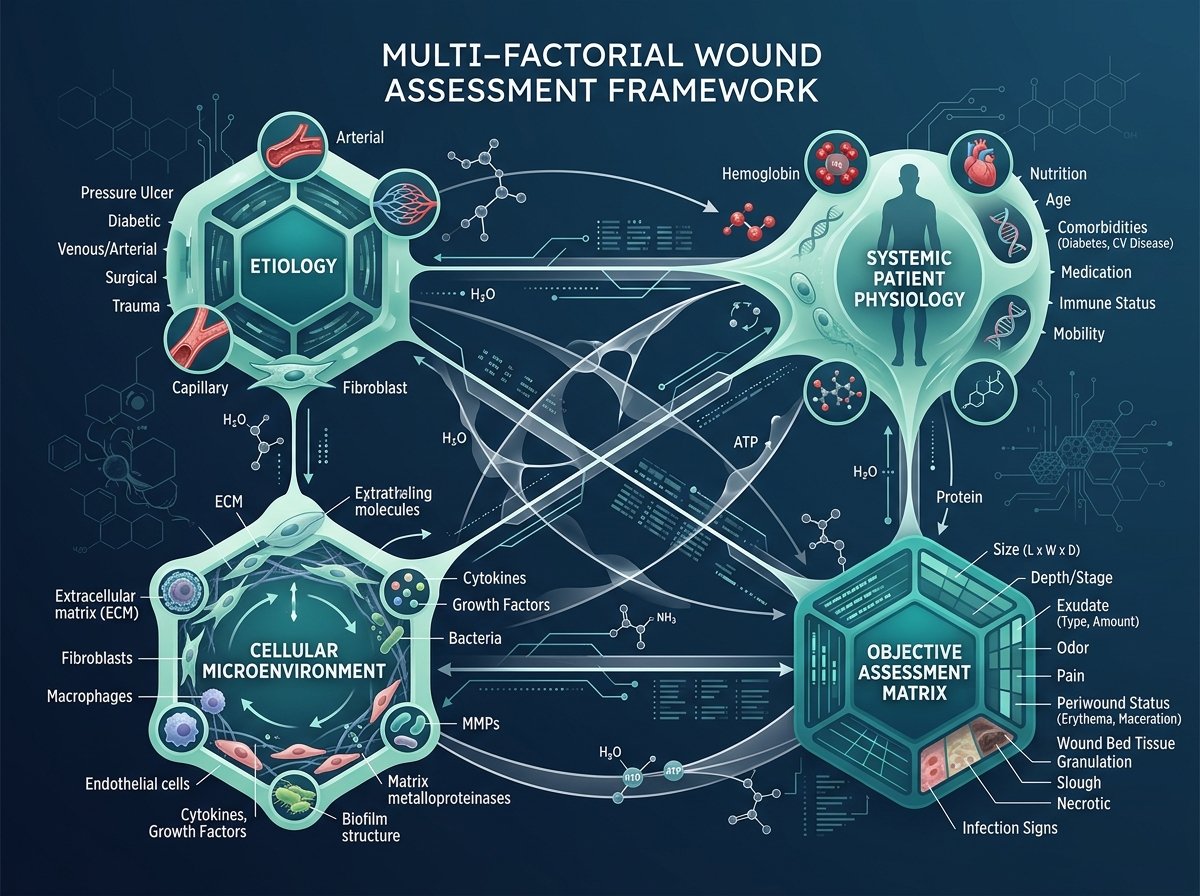
A Wound Is More Than
What We See.
A systematic understanding of the wound begins by considering three connected dimensions:
CAUSE / ETIOLOGY
The inciting mechanical, metabolic, or vascular mechanism behind tissue breakdown.
PATIENT FACTORS
Systemic perfusion, glycemic control, nutritional status, and holistic physiology.
WOUND FACTORS
Local bed composition, depth, moisture balance, microbial bioburden, and edge margin.
Interconnected physiological triad: each dimension directly influences regenerative response and healing trajectory.
What Started the Wound?
Understanding the underlying cause provides important context for the wound assessment.
What Patient Factors May Influence Progression?
Wounds do not heal in isolation. The host physiological milieu establishes the biological foundation for tissue repair.
Perfusion
Adequate macro and microvascular oxygenation delivery to the wound margins.
Diabetes / Metabolic Control
Sustained glycemic homeostasis preventing advanced glycation and immune blunting.
Nutrition
Serum albumin, zinc, ascorbic acid, and essential amino acids required for collagen matrix synthesis.
Holistic Patient Status
Non-diagnostic assessment of systemic health indicators modulating localized cellular regenerative competency.
Mobility / Offloading
Relief of mechanical shear, repetitive focal pressure, and sustained plantar loading forces.
Comorbidities
Concomitant renal insufficiency, chronic venous disease, immunosuppressive therapies, or advanced age.
What Does the Wound Tell Us?
Morphological, biochemical, and spatial characteristics observed directly at the wound bed and surrounding margin.
Location
Anatomical site informs likely vascular supply, pressure vulnerability, and offloading feasibility.
Size
Length, width, and surface area measurements tracking baseline trajectory over time.
Depth
Tissue layers involved: superficial epidermis, dermis, subcutaneous fascia, tendon, or bone.
Duration
Chronicity index signaling potential phenotypic cellular senescence and biochemical stagnation.
Pain
Nociceptive or neuropathic discomfort signaling critical ischemia, infection, or dressing trauma.
Exudate
Volume, viscosity, color, and odor indicating proteolytic balance, bacterial load, or moisture deficit.
Surrounding Skin
Peri-wound integrity: assessing maceration, erythema, induration, callosity, or contact dermatitis.
Understanding the Full Picture
Synthesizing biological variables into a cohesive, evidence-based clinical picture.
Why Do Some Wounds Fail to Progress?
In a healthy body, a wound follows a well-orchestrated path to healing. But sometimes, this journey is disrupted. Several biological and clinical factors can create barriers, keeping the wound trapped in a cycle of non-healing.
So What Is Holding the Wound Back?
A systematic wound assessment helps turn a complex wound into identifiable clinical problems.
IS THERE A TISSUE PROBLEM?
Non-viable slough, necrotic eschar, or deficient extracellular matrix hindering cellular migration.
IS INFLAMMATION OR INFECTION PERSISTING?
Persistent microbial burden, biofilm structure, or hyper-inflammatory enzymatic destruction.
IS MOISTURE BALANCED?
Excessive exudate causing peri-wound maceration, or desiccation stalling epidermal resurfacing.
IS THE WOUND EDGE ADVANCING?
Rolled epibole margins, undermining borders, or lack of centripetal epithelial bridge formation.
TIME: A Systematic Approach to Wound Assessment
The TIME framework provides a structured way to assess key aspects of the wound environment and identify factors that may be preventing progression.
TISSUE
Assess the wound bed and identify non-viable or deficient tissue.
INFECTION / INFLAMMATION
Identify factors that may delay healing.
MOISTURE
Assess and manage moisture and exudate balance.
EDGE
Evaluate wound-edge progression and surrounding tissue.
Understanding Is the First Step.
Explore the TIME framework to systematically assess the wound and identify factors that may be preventing progress.